


How to Find Profitable Crypto Arbitrage Opportunities in 2026 (Step-by-Step Guide)
Find profitable crypto arbitrage opportunities in 2026 across Ethereum, Solana, BSC & more. Build your own bot or use CoinFactory's no-code Telegram alerts.
 CoinFactory
What Are Crypto Arbitrage Opportunities?
Crypto arbitrage opportunities appear every day across Uniswap, Raydium, PancakeSwap, and hundreds of other exchanges. As liquidity becomes increasingly fragmented across Ethereum, Solana, Base, BNB Chain, Arbitrum, and other networks, the same asset can temporarily trade at different prices on different markets.
The challenge is finding these opportunities before they disappear. Monitoring thousands of trading pairs manually is nearly impossible, which is why traders typically choose one of two approaches: build their own arbitrage monitoring bot or use a ready-made solution.
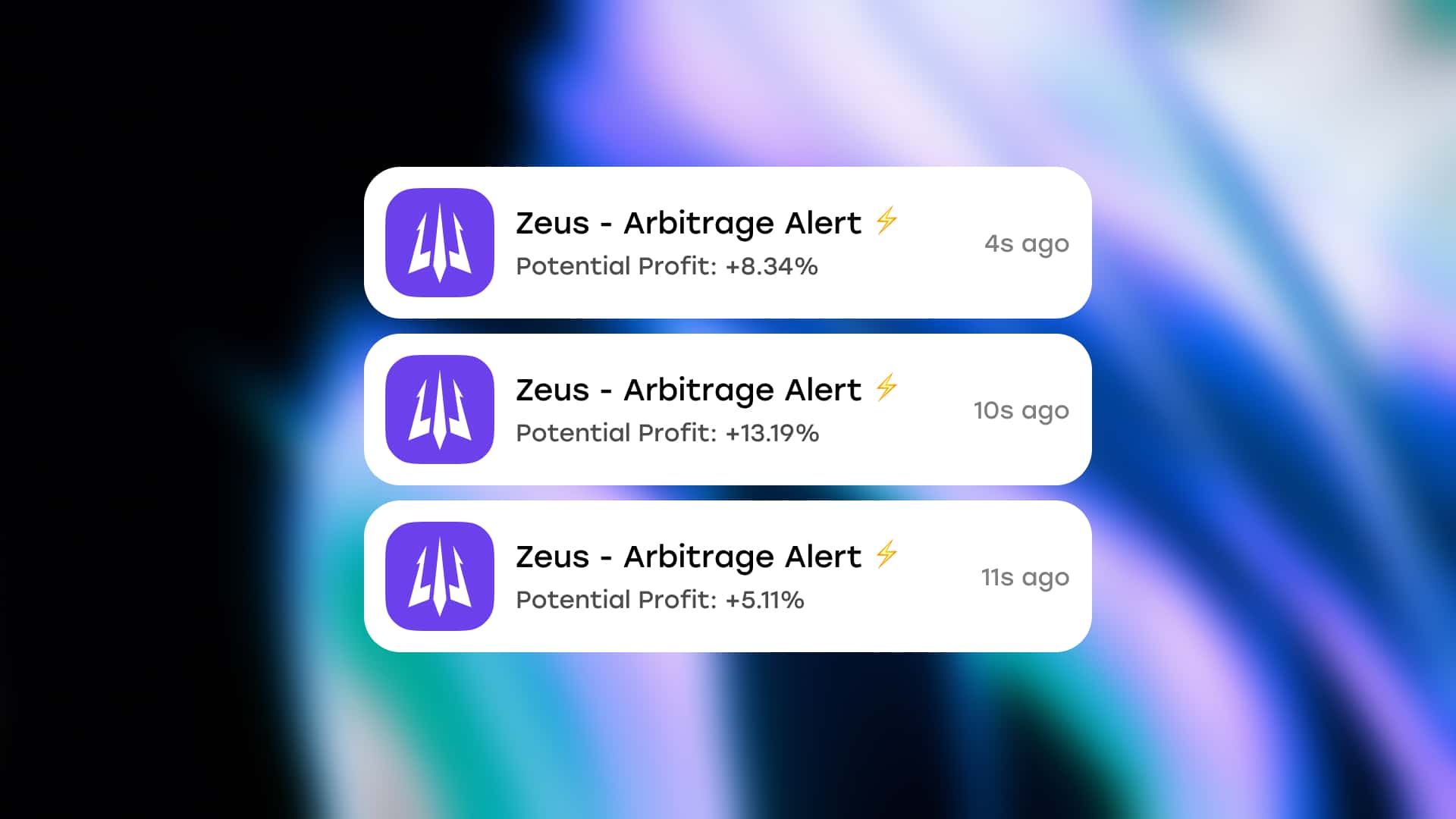
In this guide, we’ll explore how crypto arbitrage works in 2026, what it takes to build an arbitrage monitoring bot from scratch, and how tools like Zeus Bot by CoinFactory can help traders discover opportunities in real time without developing their own infrastructure.
DIY Bot Development vs. CoinFactory: A Quick Comparison
Before building your own arbitrage monitoring system, it’s important to understand the trade-offs.
Zeus Bot by CoinFactory
- ⏱️ Time to first alert: Less than 5 minutes
- 💰 Upfront cost: No development costs
- 🌐 Exchange & chain coverage: Multi-chain support out of the box
- ⚡ Infrastructure: Fully managed and optimized for real-time monitoring
- 🔧 Maintenance: Handled by CoinFactory
- 🎯 Opportunity filtering: Built-in profit and route filters
- 📲 Telegram integration: Ready to use
- 👥 Best for: Traders who want to start monitoring opportunities immediately
Build Your Own Bot
- ⏱️ Time to first alert: Days or weeks
- 💰 Upfront cost: Development time, infrastructure, and maintenance
- 🌐 Exchange & chain coverage: Must be integrated manually
- ⚡ Infrastructure: Self-hosted servers, APIs, RPC nodes, and monitoring
- 🔧 Maintenance: Ongoing updates and troubleshooting
- 🎯 Opportunity filtering: Fully customizable
- 📲 Telegram integration: Must be developed and maintained
- 👥 Best for: Developers and teams building custom trading infrastructure
For most traders, the biggest challenge isn’t finding arbitrage opportunities — it’s building and maintaining the infrastructure required to monitor them effectively. A ready-made solution like Zeus Bot allows users to focus on evaluating opportunities instead of managing APIs, servers, and exchange integrations.
The Easier Way: No-Code Bot Builder with CoinFactory
If you don’t want to spend months coding, debugging RPC latency, and maintaining infrastructure across multiple chains, CoinFactory offers a powerful shortcut.
Our platform provides access to closed beta testing of a visual constructor for cross-chain DEX arbitrage and monitoring bots. With CoinFactory’s no-code bot builder you can:
- Scan thousands of DEX pools across Ethereum, Solana, BSC, Arbitrum, Base, and more — with AI selecting the most profitable pairs in real time.
- Set custom arbitrage rules, profit thresholds, and liquidity filters per chain.
- Design beautiful, fully customizable alert templates.
- Connect directly to your Telegram channel or personal bot.
- Get built-in optimization for speed, reliability, and MEV protection.
No coding required — launch your professional-grade cross-chain DEX arbitrage monitoring bot in minutes instead of weeks.
Join the closed beta of CoinFactory’s Bot Constructor today. Early testers get priority access, custom templates for multi-chain DEX arbitrage, and direct support from our team.
Step-by-Step: How to Create the Bot (Build It Yourself)
Step 1: Create a Telegram Bot
Talk to @BotFather, create a new bot, and get the API token.
Step 2: Choose Your Tech Stack
- Node.js / TypeScript (easiest for beginners) with ethers.js or viem for EVM chains, @solana/web3.js for Solana, and node-telegram-bot-api for alerts.
- Rust or Go (best for production speed and low latency across multiple chains).
- Use real-time data sources like Alchemy / QuickNode webhooks, Helius (Solana), or The Graph subgraphs to track pool state changes.
Step 3: Set Up Multi-Chain Price Monitoring
Connect to liquidity pools across the DEXs you want to cover — Uniswap V2/V3, PancakeSwap, Raydium, Curve, Balancer, Aerodrome, and others. Monitor pool reserves and account changes for popular pairs (ETH-USDC, WBTC-USDC, SOL-USDC, major stablecoin pairs, top memecoins). Calculate implied prices on each pool and look for discrepancies greater than your threshold.
Step 4: Implement Arbitrage Logic
- Fetch quotes from aggregators like 1inch, 0x, Jupiter (Solana), OpenOcean, or Paraswap.
- Compare direct pool prices across DEXs on the same chain and across chains.
- Calculate net profit after swap fees, gas/priority fees, slippage, and bridge costs (if cross-chain).
Step 5: Telegram Notifications
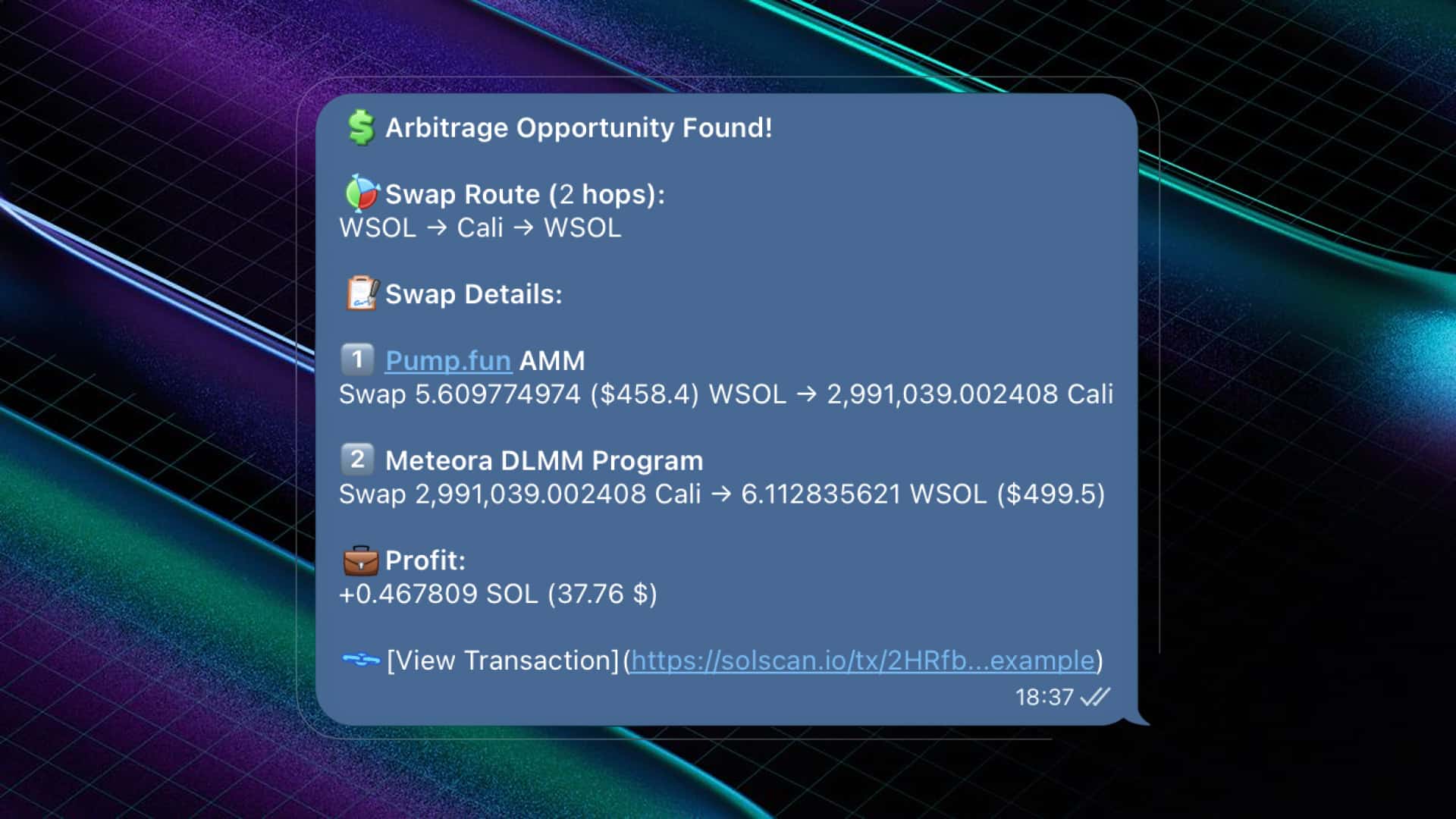
Fire an alert the moment a profitable pair clears your minimum threshold — include pair, chain, DEXs, spread %, net profit estimate, and a direct trade link.
Step 6: Hosting & Optimization
Deploy on a VPS, dedicated server, or serverless (Cloudflare Workers + durable objects). Use premium RPCs (Alchemy, QuickNode, Helius, Ankr), implement aggressive caching, proper error handling, retry logic, and rate-limit management per chain.
Challenges You’ll Face:
- RPC latency, rate limits, and node failures across multiple chains.
- False positives from stale pool data or unsynced subgraphs.
- MEV competition — sandwich bots and private mempool searchers.
- Constant updates to DEX smart contracts, pool factories, and routing logic.
- Wildly different gas economics on each chain (Ethereum vs L2s vs Solana).
Building a reliable cross-chain version from scratch can take weeks to months of development, plus ongoing maintenance every time a major DEX upgrades or a new chain gains traction.
Top Tips for Trading With a DEX Arbitrage Monitoring Bot
A monitoring bot tells you where the profit is — but how you act on the alerts decides whether you actually capture it. These are the habits that separate traders who consistently profit from those who watch opportunities slip away:
- 💙 Pre-fund wallets on every chain you trade.
- 💙 Filter aggressively for liquidity.
- 💙 Make Telegram alerts impossible to miss.
- 💙 Don’t chase every alert — track what actually fills.
- 💙 Start with small position sizes.
- 💙 Watch gas like a hawk.
- 💙 Review your performance weekly.
- 💙 Skip the FOMO trades.
Conclusion
DEX arbitrage in 2026 isn’t about being smarter than the market — it’s about seeing spreads first. The traders who profit consistently aren’t the ones with the best strategy; they’re the ones with the fastest, broadest cross-chain monitoring.
You have two paths: spend months building your own scanner across Ethereum, Solana, BSC, Base, and every new L2 — or skip straight to the alerts.
🚀 Zeus Bot by CoinFactory is now in open beta. Get early access to real-time profitable DEX pair alerts delivered straight to your Telegram, across every major chain. Fill out the form here and join the beta today — limited spots available.
The opportunities are already on-chain. The only question is who sees them first.
Tags

Guide
Crypto arbitrage
Arbitrage bot
Dex arbitrage
Trading alerts
Telegram bot